Apple added a ‘Switch to Android’ Button in iOS 26.3. It’s Their Biggest Admission in Years.
The EU just forced Apple to open its ecosystem. This isn’t just an update — it’s the end of a 15-year business model. And nobody knows yet if it’s a win.

I have a friend who switched from an iPhone 14 Pro to a Samsung S24 last year. He spent four days rebuilding his digital life. Recovering photos through Google Photos. Reconfiguring every app one by one. Losing all his iMessage conversations to the void. Re-explaining to his family why his messages were now green and they needed to disable iMessage on their end for it to work.
He told me, “It felt like moving without a truck.”
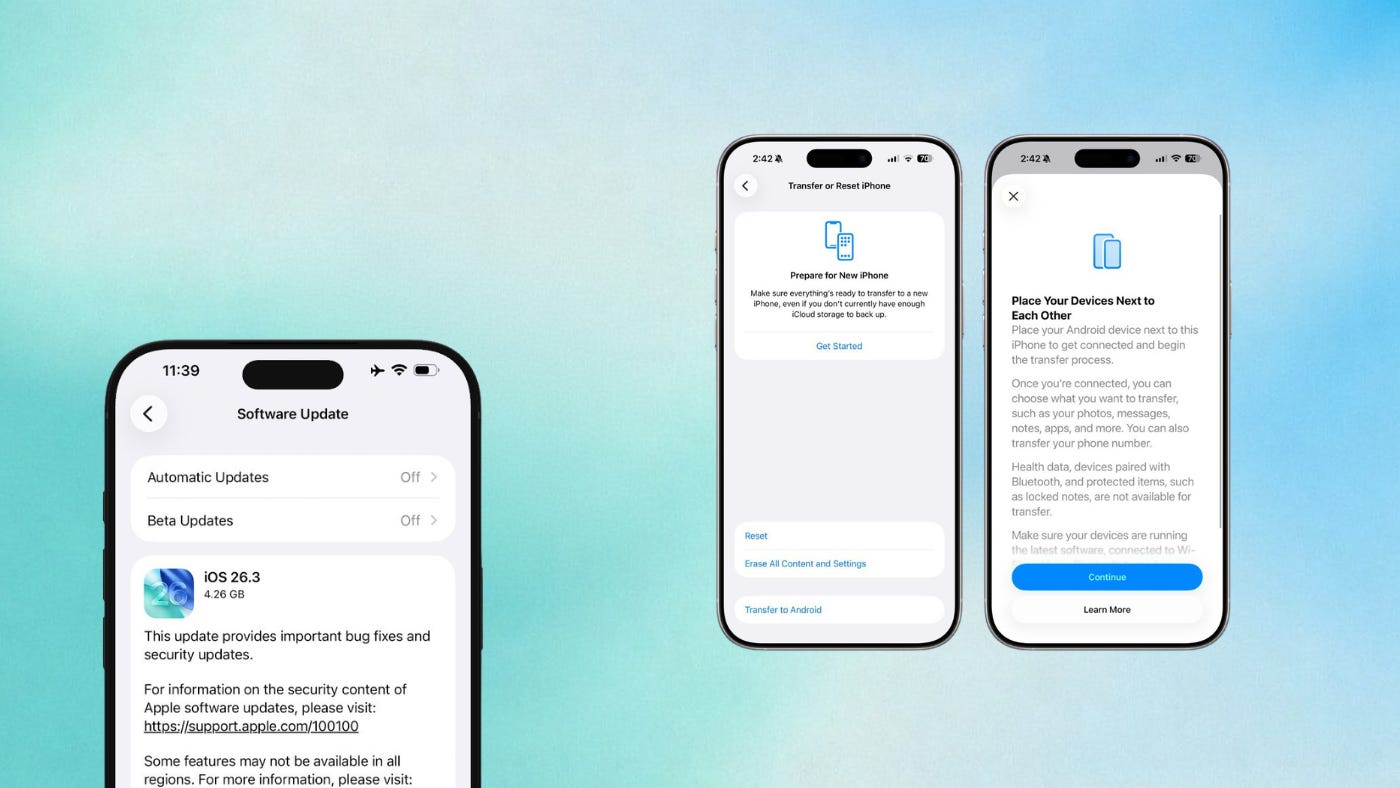
iOS 26.3 dropped this week. It’s the third major update to iOS 26 since launch. On the surface, it’s just a normal update with some nice features. Except there’s one thing that hit me in the face when I scrolled through the release notes.
Apple just turned digital divorce into an administrative procedure.
The Real Issue Nobody’s Talking About
What we’re calling a “software update” is actually a business model change forced by law.
The European Digital Markets Act — that bureaucratic thing nobody ever talks about — just did something that consumers, competitors, and American regulators couldn’t do in 15 years: force Apple to open its ecosystem.
Not because Apple had an ethical revelation. Not because Tim Cook woke up one morning thinking, “hey, let’s be more open.” No. Because the European Union said, “You open up, or we fine you billions of euros as a percentage of your global revenue.”
And Apple calculated. They ran the cold math every company runs when facing regulation: how much does it cost to resist vs how much does it cost to comply.
Compliance costs less.
But here’s what nobody’s saying: for 15 years, Apple built its empire on a simple promise. Buy an iPhone, and everything will work perfectly together. iPhone, iPad, Mac, Apple Watch, AirPods. One ecosystem. One experience. No friction.
Except “no friction” also meant “impossible to leave without losing everything.” AirDrop only works between Apple devices. Handoff that lets you continue what you were doing on another device. iMessage that turns your Android friends into second-class green bubbles. An Apple Watch that refuses to work with an Android phone.
These weren’t bugs. They were features. Strategic lock-in features.
The closed ecosystem wasn’t a side effect of excellence. It was the plan.
And iOS 26.3, with its clean little “Transfer to Android” button, is Apple implicitly admitting this plan no longer holds up against regulatory pressure. They’d rather control the exit than suffer it.
What This Says About Us
We’re discovering that friction was a feature.
For years, when you asked someone why they stayed with Apple, you always heard the same thing: “It just works.” “It’s smooth.” “Everything talks to each other.”
And it was true. AirDrop to send photos between iPhones in two seconds. Handoff to start an email on your Mac and finish it on your iPhone. iMessage syncing conversations everywhere. Apple Watch automatically unlocks your Mac.
Except we’re realizing now that this “magic” had a hidden price: the impossibility of leaving without losing that magic.
You could technically buy an Android. But you knew you’d lose AirDrop with your friends. That your watch would become an expensive paperweight. That your iMessage conversations would disappear into the void. That your parents would ask why “it doesn’t work like before.”
The friction to leave was so high that most people never left. Not because they absolutely loved iOS. But the exit cost was psychologically unbearable.
It’s like if Ikea sold furniture with proprietary screws. Technically, you can buy elsewhere. But you know your new shelves will never fit with the old ones. So you buy Ikea again. And again.
Attention: But friction also created real value. When everything’s designed to work together, it creates a coherent experience no open ecosystem has ever managed to replicate. Android + Windows + Fitbit + Pixel Buds works. But it doesn’t work as well as a closed, optimized ecosystem. The question is whether this coherence justifies the lock-in.
Our ambivalence toward freedom
Here’s something weird: we demand freedom of choice, but we secretly love not having to choose.
Look at the reactions on Twitter and Reddit since the iOS 26.3 announcement. Half the people say, “FINALLY, Apple stops locking us in!” The other half says, “But wait, if I can use a Samsung Watch with my iPhone, will it break everything?”
We want to be able to leave. But we also want everything to work perfectly without effort.
This is exactly our relationship with tech platforms in 2026. We want Instagram’s freedom, but we want TikTok’s algorithm. We want Signal’s privacy, but we want everyone to be on WhatsApp. We want an open internet, but we want the simplicity of a curated App Store.
iOS 26.3 exposes this ambivalence in broad daylight. Apple now tells you: “OK, you want a Samsung Watch? You can. But we guarantee nothing about the experience.”
And honestly? I get both sides. There are people for whom freedom of choice is paramount, even if it means managing complexity. And there are people for whom the simplicity of a well-maintained walled garden is worth every compromise in the world.
Apple is testing whether we love their product or just their golden cage.
Both positions are legitimate. But we can’t pretend anymore, we just have “a preference” — we now have to actively own that we’re choosing between freedom and simplicity.
Attention: Some users genuinely, sincerely prefer a closed ecosystem. Not out of ignorance or laziness. But because they’ve made the conscious calculation that their time is worth more than the theoretical freedom to choose between 47 smartwatch models. And that’s OK. The problem is when this choice is imposed by default rather than offered as an option.
Europeans as involuntary guinea pigs
Here’s what’s fascinating: iOS 26.3 opens Apple’s ecosystem… but only in the European Union.
If you’re in France, you can now connect a Samsung Watch to your iPhone. If you’re in the US or Canada, you can’t. Same iPhone, same iOS 26.3, different rules based on your GPS location.
Why?
Because Apple’s running a real-world experiment. They want to know if forced openness will kill their business model or just wound it.
If Europeans start massively using non-Apple products with their iPhones, and Apple Watch/AirPods sales collapse in Europe, Apple will have proof that the closed ecosystem was essential to their profitability. They can tell American regulators, “Look what happened in Europe, do you really want to break our model?”
If, instead, Europeans keep buying Apple massively despite the freedom to leave, Apple will have proven its product holds up without lock-in. And they can eventually open everywhere without risking their margins.
The 450 million Europeans just became guinea pigs in a giant economic experiment. And nobody asked their opinion.
Attention: Or — let’s be honest — the European Union is actually protecting consumers by breaking de facto monopolies. No need for easy cynicism. It’s possible the DMA is just… good regulation. Forcing interoperability is better for everyone long-term, even if Apple loses in the process.
The Blind Spot in This Analysis
OK, let’s be honest for a second.
This entire analysis assumes an open ecosystem is objectively better than a closed one. That freedom of choice always trumps coherence of experience.
But what if that’s wrong?
What if forced openness actually kills what made Apple valuable? Not just their business model, but the real value they bring to users?
Think about it: when you buy an iPhone, an Apple Watch, AirPods, or a MacBook, you know exactly what you’re getting. Zero configuration. Zero incompatibility. Zero “Oh shit, it doesn’t work.” Everything works together out of the box.
This coherence has an enormous R&D cost. Apple can afford it because they control everything. If tomorrow you can use any watch, any earbuds, any operating system with an iPhone, Apple loses that total control capability.
And maybe in 5 years, we’ll look back at iOS 26.3 thinking: “That’s when Apple became as fragmented and incoherent as Android. We won freedom, we lost the magic.”
I could be wrong. Completely. It’s possible that:
Competitive pressure forces Apple to innovate rather than lock in
Users genuinely prefer freedom to coherence
An open ecosystem creates more global value than a closed one
But it’s also possible the opposite is true. And that we’re breaking something that worked, in the name of theoretical freedom nobody will actually use.
What This Means for You
The real question isn’t whether you can leave, but why you stay.
OK, enough philosophy. What does this actually mean for you, average user with an iPhone in your pocket?
Three questions you’ll need to ask yourself in the coming months:
1. Does your Apple loyalty survive the freedom to leave?
Before iOS 26.3, staying with Apple was partly a default choice. The exit cost was too high. Now, leaving becomes a real option. Which means staying becomes a conscious choice.
Are you staying because you love iOS? Or because you loved not having to ask the question?
2. Is a closed, excellent ecosystem better than an open, mediocre one?
If you can now mix iPhone + Samsung Watch + Sony earbuds + Windows PC, do you do it? Or do you realize that all-Apple, even imperfect, simplifies your life so much you don’t want to manage 4 different brands?
Because freedom of choice comes with the responsibility to choose. And managing compatibility between ecosystems is a part-time job.
3. Are you ready to handle the complexity of freedom?
I saw this testing the iOS → Android transfer. It works at 85%. That’s already incredible compared to before. But that remaining 15% — your Apple Health data, your Notes, your Reminders, your iMessage conversations — they disappear into the void.
Can you live with that? Or does that 15% represent exactly the stuff that matters most to you?
iOS 26.3 changes nothing short-term. My iPhone works exactly the same as yesterday. My AirPods still connect instantly. My Watch still displays my notifications.
But in 5 years, I think we’ll look back at this update as the moment Apple stopped being a religion and became a brand again. When we went from “locked-in believers” to “customers who choose.”
When leaving becomes easy, staying becomes a conscious choice.
And honestly? I don’t know yet if that’s good news or bad news.
Thanks for reading! Want to receive my next articles directly in your inbox? Subscribe! And don’t forget to hit the share button to help spread the word.